From Software Engineer to AI Engineer: A Guide for Contractors
17 Aug, 20267 minsAI engineer jobs are becoming some of the fastest-growing opportunities in enterprise techno...


AI engineer jobs are becoming some of the fastest-growing opportunities in enterprise technology. Here's why experienced software engineers are making the transition and what organisations are really looking for.
Key Takeaways
- AI Engineer jobs are growing because organisations need experienced engineers to implement enterprise AI.
- Software engineer contractors already possess many of the technical skills employers are looking for.
- Practical AI implementation experience is often more valuable than certifications.
- Enterprise AI projects increasingly require integration, cloud and governance expertise.
- Contractors who gain AI experience now are well positioned for future demand.
AI Has Created a New Type of Software Engineer Job
Artificial intelligence is no longer something organisations are experimenting with. It's becoming part of everyday software delivery.
Yet despite enterprise investment accelerating, adoption remains inconsistent. Recent research found that while access to AI tools has increased significantly, fewer than 60% of employees with approved access actually use them in their daily work. At the same time, 84% of organisations admit they still haven't redesigned roles or workflows to fully integrate AI into the business.
This gap between investment and implementation is creating one of the fastest-growing roles in enterprise technology: the AI Engineer.
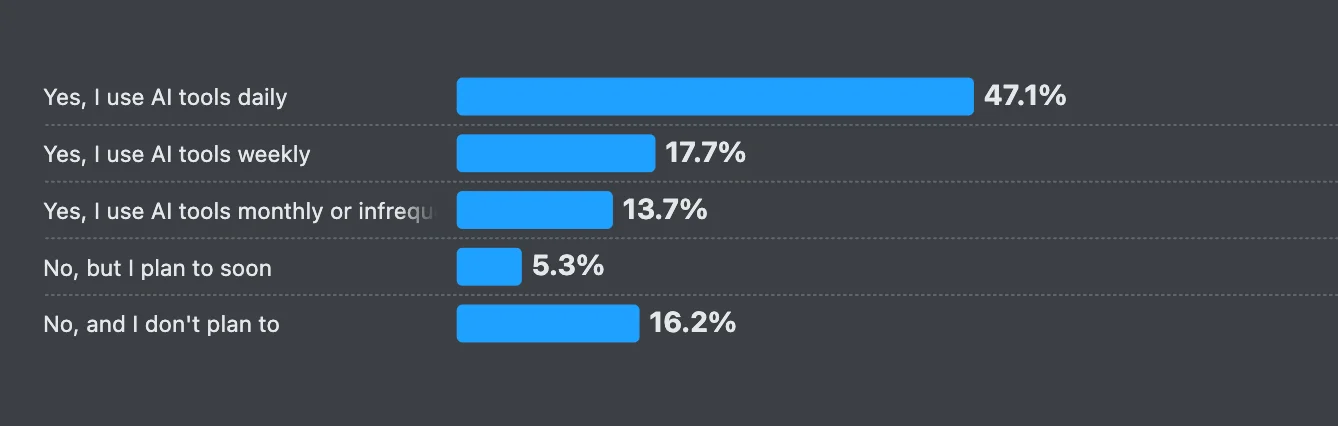
Source: AI | 2025 Stack Overflow Developer Survey
Although AI access continues to grow, daily adoption remains much lower, underscoring the need for experienced engineers who can turn AI investments into practical business outcomes.
At MA, we're seeing this first-hand. Organisations are no longer asking whether they should invest in AI. They're looking for experienced software engineers who can help integrate AI into enterprise systems, redesign workflows and deliver measurable value from the technology. As demand for AI engineer jobs continues to grow, experienced software engineer contractors are well positioned to apply their existing skills to enterprise AI projects.
For software engineer contractors, this shift is creating new opportunities rather than replacing existing ones. Clients are increasingly looking beyond traditional software engineer jobs, instead seeking contractors who can combine strong engineering fundamentals with practical AI implementation experience. As a result, AI engineer jobs and AI engineer contract jobs are becoming a natural next step for experienced engineers looking to specialise, rather than a completely separate career path.
The challenge is that AI engineering is still a relatively new discipline. Unlike traditional software engineer jobs, there isn't a single career path, recognised qualification or playbook for making the transition. Instead, organisations are looking for experienced engineers who understand enterprise technology and can apply AI to solve real business problems. That's why many of today's AI Engineers have backgrounds in software engineering, cloud, data or platform engineering rather than AI itself.
How Can Software Engineer Contractors Move into AI Engineering?
Many contractors assume that moving from software engineer jobs into AI requires starting your career again. In reality, many of today's AI Engineers began their careers as Software Engineers, Cloud Engineers or Data Engineers before gradually building AI expertise alongside their existing technical skills.
That's because many of the core skills hiring managers are increasing value on already exist within an experienced software engineering team. Such as building APIs, developing scalable applications, working with cloud infrastructure, integrating enterprise systems and solving complex technical problems all provide a strong foundation for AI engineering.
The difference is that AI Engineers apply those same principles to intelligent systems, helping organisations integrate AI into existing platforms, automate business processes and build applications powered by LLMs.
Rather than replacing software engineering, AI is creating a natural progression for contractors who want to specialise in one of enterprise technology's fastest-growing areas.
Software Engineering Skills That Transfer to AI Engineering
Software Engineering | AI Engineering |
|---|---|
API Development | AI Integrations |
Backend Development | LLM Applications |
Cloud Infrastructure | AI Deployment |
Security | AI Governance |
Software Architecture | AI Architecture |
Testing | AI Evaluation & Monitoring |
How to Build AI Engineering Experience Without Starting Again
Most organisations aren't hiring AI Engineers because they've spent years working exclusively in AI. They're hiring experienced engineers who have begun applying AI within real enterprise projects.
Whether that's integrating AI services into existing applications, automating workflows or supporting proof-of-concept initiatives, practical experience is often what separates a strong AI Engineer from someone with AI knowledge alone.
AI engineering is less about learning an entirely new profession and more about applying your existing engineering expertise in a new context.
Start with AI Inside Your Current Contract
If you're already working as a software engineer contractor, one of the easiest ways to begin the transition is by looking for AI opportunities within your existing project.
Many organisations are already experimenting with tools such as GitHub Copilot, Microsoft Copilot, Azure AI or OpenAI APIs, even if they haven't yet created dedicated AI Engineer roles. Volunteering to support these initiatives allows you to gain commercial AI experience while continuing to deliver the software engineering work you already know.
From a contractor's perspective, this can be far more valuable than completing another certification. Clients want to see evidence that you've applied AI within real enterprise environments, whether that's automating development workflows, integrating AI into existing applications or supporting proof-of-concept projects.
Learn Enterprise AI, Not Just AI
There's no shortage of online courses teaching prompt engineering or how to build simple AI applications.
However, that's rarely what organisations are hiring for.
The majority of AI engineer jobs and AI engineer contract jobs sit within enterprise environments, where the challenge isn't building an AI model from scratch, it's integrating AI into complex technology ecosystems that already exist.
That means understanding:
- APIs and enterprise integrations
- Cloud platforms such as Azure or AWS
- Data pipelines and governance
- Security and compliance
- Legacy applications and system architecture
For software engineer contractors, these are often the skills that separate someone who can experiment with AI from someone who can successfully deliver an enterprise AI project.
Build Experience Before Chasing the Job Title
Another common mistake is focusing too heavily on the job title itself.
Many organisations aren't advertising for "Contract AI Engineers" yet. Instead, they're hiring Software Engineer, Platform Engineer or Cloud Engineer contractors with experience supporting AI initiatives.
If your goal is to move into AI engineer contract jobs, don't wait until the perfect title appears. Focus on building the experience first.
The contractors who are making the transition most successfully are those who can demonstrate they've worked on AI-enabled projects, even if AI wasn't their primary responsibility.
What Technology Recruiters Look for in AI Engineer Contractors
As specialist technology recruiters, one significant change we're seeing is that organisations are placing less emphasis on theoretical AI knowledge and more emphasis on practical delivery experience.
This growing demand is already being reflected in hiring priorities. According to Gartner, 56% of software engineering leaders identified AI and machine learning engineers as the most in-demand role, while applying AI to enterprise applications was highlighted as the industry's biggest skills gap.
While technical skills remain essential, clients working with specialist technology recruiters are increasingly looking for contractors who can demonstrate how they've applied AI within real business environments.
Commercial Project Experience
Have you worked on an AI implementation, automation project or proof of concept?
Even if AI formed only a small part of the wider project, being able to explain your contribution can significantly strengthen your CV.
Enterprise Thinking
Building an AI application is one thing. Deploying it securely across an enterprise organisation is another.
Contractors who understand governance, security, integrations and scalability are often far more attractive than candidates who only have experience building standalone AI applications.
Business Understanding
The strongest AI Engineer contractors don't just understand technology, they understand why the business is investing in AI in the first place.
Being able to discuss productivity improvements, process automation or customer outcomes demonstrates that you think like a consultant rather than simply a developer.
A Commitment to Continuous Learning
AI is evolving faster than almost any other area of enterprise technology.
Clients don't expect contractors to know everything. They do expect them to demonstrate curiosity, stay up to date with new tools and continuously develop their skills.
Where Are AI Engineer Contractors In-Demand?
One of the reasons AI engineer jobs are growing so quickly is that AI is no longer limited to technology companies.
Across almost every industry, organisations are expanding their use of AI to improve products, streamline operations and enhance customer experiences. While many large enterprises have already introduced AI, the focus has shifted towards scaling deployments, integrating new capabilities and continuously improving existing solutions.
We're seeing increasing demand across sectors including:
- Financial Services
- Healthcare and Life Sciences
- Manufacturing
- Retail and eCommerce
- Energy
- Public Sector
Within these organisations, AI Engineers are supporting projects such as integrating AI into enterprise applications, automating business processes, improving customer experiences and delivering the next phase of AI transformation.
For contractors, this creates opportunities across a much wider range of industries than many people expect.
Is AI Engineering the Right Next Step?
For experienced software engineer contractors, AI engineering shouldn't be viewed as a completely new career, it should be viewed as the next evolution of one.
The demand for strong software engineering fundamentals hasn't disappeared. If anything, it's become more important. Organisations still need engineers who understand architecture, integrations, cloud technologies and enterprise software development. That's why software engineer contractors remain well positioned to transition into AI engineer contract jobs as demand continues to grow. .
If you're already building enterprise applications, working with cloud platforms or integrating complex systems, you're likely closer to becoming an AI Engineer than you think.
The most successful transitions won't come from chasing a new job title. They'll come from gradually building AI experience alongside the technical expertise you've already spent years developing.
5 Mistakes Software Engineer Contractors Make
- Waiting for an "AI Engineer" job title – Many contractors gain AI experience within software engineering roles before officially moving into AI engineer contract jobs.
- Prioritising certifications over commercial experience – Clients value real-world AI implementation and enterprise project experience more than certifications alone.
- Overlooking enterprise integration skills – AI projects rely on APIs, cloud platforms, security, data and system integrations as much as AI knowledge itself.
- Failing to showcase AI experience on your CV – If you've worked with GitHub Copilot, Microsoft Copilot, Azure AI or AI-powered automation, make sure it's clearly highlighted.
- Assuming AI replaces software engineering – The strongest AI Engineer contractors build on their software engineering expertise rather than replacing it.
Ready to Transition into AI Engineering Contracting?
As demand for AI engineer contract jobs continues to grow, experienced software engineer contractors are well placed to build on their existing expertise and support the next generation of enterprise AI projects.
At Montreal Associates, our specialist technology recruiters work with experienced contractors across software engineering, cloud, AI and enterprise technology, connecting them with organisations delivering complex transformation programmes around the world.
If you're an experienced software engineer looking to expand your AI experience or secure your next enterprise AI contract, explore our latest contract opportunities or speak to our specialist technology recruitment team today.
FAQs About AI Engineer Contract Jobs
How can software engineer contractors transition into AI engineering?
The strongest candidates build on their existing experience by working on AI implementation projects, developing integration skills and gaining exposure to enterprise AI tools within their current contracts. Organisations increasingly value contractors who can combine software engineering expertise with practical AI delivery experience.
What experience do clients look for in AI engineer contractors?
Many organisations hiring for AI engineer contract jobs are looking for contractors with experience in enterprise software development, APIs, cloud platforms and system integration. Practical experience delivering AI-enabled projects is often more valuable than completing multiple AI certifications.
Are AI engineer contract jobs replacing software engineer jobs?
No. In most organisations, AI engineering is an extension of software engineering rather than a replacement for it. Many AI engineer contract jobs are filled by experienced software engineer contractors who have expanded their skills to include AI implementation, automation and enterprise integration.
Which industries are hiring AI engineer contractors?
Demand for AI Engineer contractors is growing across financial services, healthcare, life sciences, manufacturing, retail and the public sector. Organisations implementing enterprise AI often bring in contractors to accelerate delivery, provide specialist expertise and support complex transformation programmes.
Why should software engineer contractors consider moving into AI?
AI engineering allows contractors to build on existing software engineering skills while specialising in one of the fastest-growing areas of enterprise technology. As organisations continue investing in AI, contractors with practical implementation experience are becoming increasingly valuable across a wide range of enterprise projects.
Related Posts

Employee vs Independent Contractor in Canada
02 Sept, 2026