The Executive's Guide to Building AI Leadership Teams in Europe
20 Aug, 20267 minsAI has firmly established itself as a boardroom priority. Across Europe, organisations are m...



AI has firmly established itself as a boardroom priority. Across Europe, organisations are moving beyond experimentation and asking a different question: how do we build a leadership team capable of turning AI ambition into business value?
For many executives, the challenge isn't deciding whether AI belongs in the business. It's determining who should lead it, how responsibilities should be shared and what skills are needed to scale AI successfully.
Should AI sit with the CTO? Does the Chief Data Officer take ownership? Is it time to appoint a Chief AI Officer? Or should responsibility be distributed across the executive team?
There isn't a single answer. Every organisation's AI journey is different. But one thing is becoming increasingly clear: the businesses making the greatest progress aren't simply investing in better technology. They're rethinking leadership.
Drawing on insights from Elliott Delente, Director of Permanent Recruitment at Montreal Associates and founder of the AI Leaders Club, this guide explores how organisations across Europe are approaching AI leadership, the different models emerging across the market and what executives should consider when building their own AI leadership team structure.
AI Adoption Across Europe Is Accelerating
Europe's AI landscape is changing rapidly.
According to Eurostat data, 20% of EU enterprises with 10 or more employees were using AI technologies in 2025, up from 13.5% in 2024 and fewer than 8% in 2021.
Among large enterprises, adoption has already reached 55%, while 70.3% of organisations that haven't yet adopted AI cite a lack of relevant skills as their biggest barrier.
The picture across Europe is equally diverse. Nordic countries continue to lead AI adoption, while other markets remain in the earlier stages of their AI journey. For organisations operating across multiple countries, this creates an additional leadership challenge: different markets often require different approaches to AI maturity, governance and talent.
Read our guide to AI adoption across Europe.
As AI adoption accelerates, executive teams are discovering that implementing AI is only part of the challenge. The bigger question is how to organise leadership so AI delivers long-term business value.
The Leadership Challenge Facing European Organisations
A year ago, most conversations about AI focused on technology. Today, they focus on leadership.
Executives aren't asking whether AI has potential. They're asking how to organise their businesses to make the most of it.
As Elliott Delente explains:
"Companies can struggle at scale because they are unsure how to organise leadership, organise talent or speed up processes."
Elliott's perspective is reflected in wider market research. While AI adoption continues to grow, relatively few organisations are translating that investment into measurable business outcomes.
According to recent research, only 6% of organisations qualify as AI high performers, attributing a significant share of EBIT to AI. This suggests the challenge is no longer simply adopting AI. It's creating the leadership, governance and organisational alignment needed to generate value from it.
Three AI Leadership Models Emerging Across Europe
One of the biggest misconceptions surrounding AI is that every organisation needs the same leadership structure.
In reality, the right AI leadership team structure depends on business size, AI maturity and strategic ambition. Through conversations with AI leaders across Europe, three broad approaches are emerging.
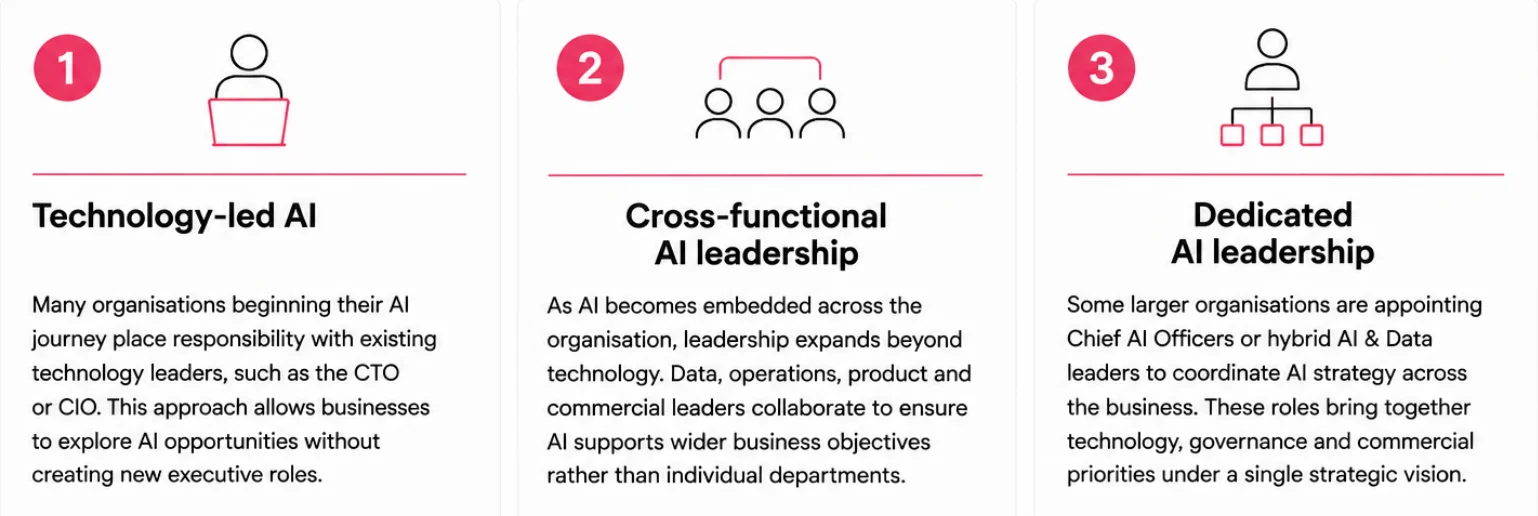
1. Technology-led AI
Many organisations beginning their AI journey place responsibility with existing technology leaders, such as the CTO or CIO. This approach allows businesses to explore AI opportunities without creating new executive roles.
2. Cross-functional AI leadership
As AI becomes embedded across the organisation, leadership often expands beyond technology. Data, operations, product and commercial leaders collaborate to ensure AI supports wider business objectives rather than individual departments.
3. Dedicated AI leadership
Some larger organisations are appointing Chief AI Officers or hybrid AI and Data leaders to coordinate AI strategy across the business. Rather than replacing existing executives, these roles often bring together technology, governance and commercial priorities under a single strategic vision.
There is no universal blueprint. Many organisations evolve between these models as their AI capability matures.
Five Questions Every Executive Team Should Ask Before Scaling AI
Once AI moves beyond experimentation, leadership decisions become just as important as technology decisions.
Before expanding AI initiatives, executive teams should consider:
Who owns our AI strategy?
Clear ownership helps prevent duplicated effort and ensures AI initiatives align with wider business priorities.
Are we solving business problems?
The most successful AI programmes begin with commercial objectives, not technology.
Do we have the right data foundations?
Strong governance and trusted data remain essential for scaling AI successfully.
Do we have the right leadership around the table?
AI initiatives increasingly require collaboration between technology, operations, product and business leadership rather than relying on one executive alone.
Are we preparing our people for change?
Successful AI adoption depends as much on organisational change as it does on technical implementation.
These questions don't have universal answers, but they provide a useful framework for evaluating whether your organisation is ready to move from AI experimentation to enterprise-wide adoption.
Finding AI Leaders in Europe's Competitive Market
Building an AI leadership team is becoming as much a talent challenge as a technology challenge.
While demand for experienced AI leaders continues to grow, the market remains relatively small. Organisations are no longer looking solely for technical specialists. They're looking for leaders who can connect technology with commercial strategy, navigate organisational change and build cross-functional teams.
Elliott has also seen increasing demand for leaders from operations, product and transformation backgrounds, professionals who understand how to embed AI across an organisation rather than simply implement new technology.
This evolution is changing the way organisations approach AI leadership recruitment. Rather than hiring purely for technical expertise, businesses are increasingly seeking executives who can align AI with long-term business strategy.
For many organisations, this also means partnering with specialist AI executive recruiters who understand both the technology landscape and the realities of executive hiring across Europe.
If your organisation is considering whether to appoint a Chief AI Officer, we've explored that topic in more detail in our guide: The Rise of the Chief AI Officer.
Building an AI Hiring Strategy for Long-Term Success
An effective AI hiring strategy should be aligned with your organisation's long-term business goals and AI ambitions.
Rather than asking, "Who should we hire first?", executive teams should consider which leadership capabilities will have the greatest impact over the next three to five years. For some organisations, that may mean strengthening existing technology leadership. For others, it may involve appointing specialist AI executives or introducing external expertise as AI programmes evolve.
At MA, we've seen that the most successful organisations don't build AI leadership teams overnight. They take a strategic approach to AI leadership recruitment, hiring the right leaders at the right stage of their AI journey to support sustainable growth and long-term business outcomes.
Hiring AI Leaders: Think Beyond Today's Needs
As AI adoption continues to accelerate across Europe, leadership is becoming a defining competitive advantage.
There is no single model for building an effective AI leadership team structure, and organisations will continue to evolve their approach as the technology matures. What matters is creating leadership teams that can align AI with business strategy, foster collaboration across functions and guide organisations through change.
At MA, we work with organisations across Europe to identify the executive talent shaping the future of AI. Whether you're reviewing your AI hiring strategy, exploring AI executive search or planning your next senior appointment, our consultants understand the European market and the leadership challenges organisations face as AI continues to evolve.
FAQs About Building AI Leadership Teams
What is the best AI leadership team structure?
The best AI leadership team structure depends on your organisation's size, industry and AI maturity. Most businesses adopt a collaborative approach, with AI responsibilities shared across technology, data and business leaders.
Does my organisation need a Chief AI Officer?
Not always. Some organisations appoint a Chief AI Officer, while others share AI leadership across existing executives until their AI strategy matures.
Who should be responsible for AI in an organisation?
AI should be owned collectively. Depending on the organisation, leadership may sit across the CTO, CIO, Chief Data Officer and other business leaders, with some businesses also appointing a Chief AI Officer.
How do organisations recruit AI leaders?
Many organisations use specialist AI executive search firms to find experienced leaders with the technical, commercial and strategic skills needed to accelerate AI adoption successfully.
Which AI leadership role should I hire first?
Your first AI leadership hire depends on your current team. Many organisations strengthen existing technology leadership before appointing a dedicated AI executive as their AI strategy evolves.
How do I scale my AI team?
Start with leadership, not headcount. Define ownership, align AI with business goals and build the right foundations before expanding your technical team.
How do I incorporate AI into my business?
Begin with a clear business challenge rather than the technology itself. Identify where AI can create value, build strong data foundations and scale gradually as capability grows.
Related Posts

AI Executive Search in Europe: A Country Guide
10 Aug, 2026