Free Tech Resume Template (ATS-Friendly Download)
25 Mar, 2026

One of the most common things I hear from candidates is, “I’ve applied to loads of role...


One of the most common things I hear from candidates is,
“I’ve applied to loads of roles and I’m not hearing anything back.”
And honestly, most of the time it’s not because you’re not good enough.
It’s usually because your resume isn’t aligned with what the role actually requires.
That’s the part people underestimate. They think they need to completely rewrite their resume or make it sound more impressive. But when I look at it, the issue is often much simpler than that.
It’s not tailored. It’s not using the same language as the job. And it’s not making it obvious, quickly, that this person matches what we’re hiring for.
So this isn’t just about how to tailor a resume for tech jobs. It’s about understanding why resumes get filtered out in the first place, and what actually changes the outcome.
If you’re starting from scratch or want to improve your overall structure, you can read our full guide on how to write a tech resume here.
I see this all the time. Someone will send over a resume that looks good. It’s clean, it’s well written, the experience is there.
But when you compare it directly to the role they’ve applied for, the connection isn’t obvious.
And that’s where things fall down.
Recruiters and hiring managers aren’t reviewing your resume in isolation. We’re always looking at it in the context of a specific job. So even if your experience is strong, if it doesn’t clearly map to what that role needs, it’s very easy to move on to the next candidate.
It’s not always a conscious decision either. It’s just that we’re scanning quickly, and we’re looking for alignment straight away.
Before your resume even reaches someone like me, it’s often going through an Applicant Tracking System.
And the way these systems work is quite simple. They’re not trying to understand your potential or read between the lines. They’re just looking for patterns.
They scan for things like job titles, specific tools, technologies, and keywords that match the job description. If those things aren’t clearly there, your resume can get filtered out early.
That’s why two people with very similar experience can get completely different results. One resume matches the role closely, the other doesn’t.
And the frustrating part is, from the candidate’s perspective, it can feel like you’re doing everything right.
This is why understanding how to optimise your resume for ATS systems is so important in today’s hiring process.
At this point, most candidates have heard that keywords matter.
So what they do is add a long list of tools or skills into their resume and assume that’s enough.
But that’s not really how it works in practice.
Keywords on their own don’t carry much weight if they’re not used in context. And when they’re just listed without explanation, it doesn’t help a recruiter understand what you’ve actually done.
So the issue isn’t whether you have the right keywords. It’s how you’re using them.
This is the part I always tell people to slow down on, because it makes the biggest difference.
Instead of applying straight away, take a few minutes to properly look at the job description.
Open a few similar roles side by side, ideally for the exact position you’re targeting. If you’re going for backend developer roles, look at multiple backend roles. Same for DevOps, data, or cloud.
When you scan through them, you’ll start to notice patterns. The same tools, the same responsibilities, the same types of experience keep coming up.
That’s what you need to focus on.
Not everything in the job description matters equally. It’s those repeated themes that tell you what the role actually prioritises.
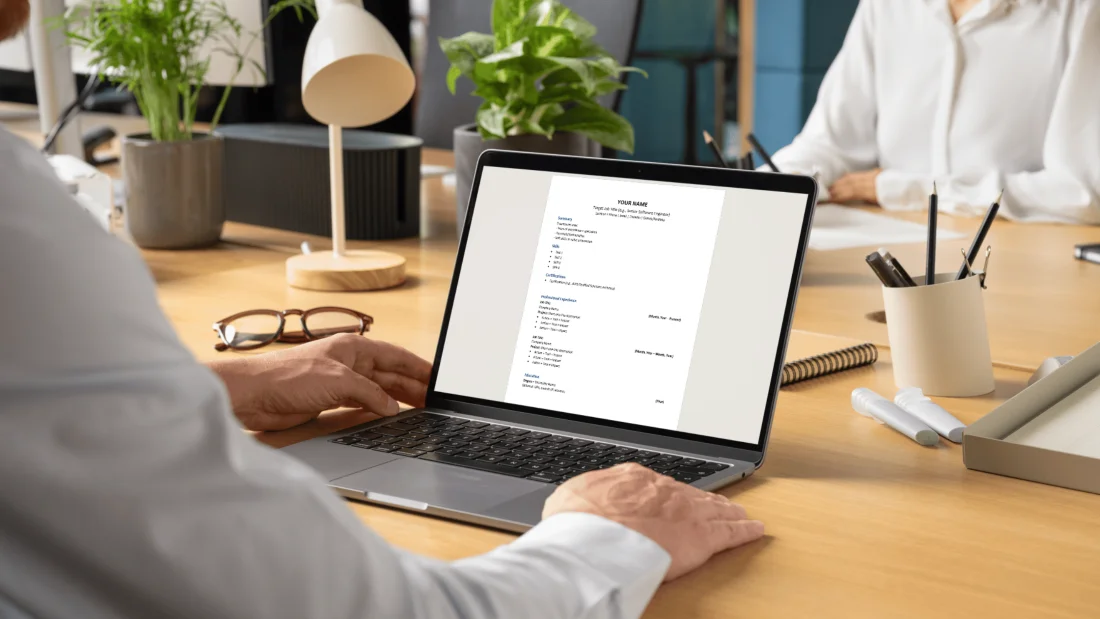
Once you see that, it becomes much easier to adjust your resume so it speaks the same language. If you want a starting point, you can use our free tech resume template to structure this properly.
Tailoring doesn’t mean rewriting your entire resume every time. It’s more about shifting the emphasis.
So instead of describing your experience in a broad way, you’re highlighting the parts that are most relevant to that specific role.
For example, saying you’ve “worked with cloud technologies” is quite vague. But if the role is focused on AWS, you want to be clear about that. You want to show how you’ve used it, what you’ve built, and what the outcome was.
That’s what makes your experience feel aligned rather than generic.
This is something I’m quite honest about with candidates.
If you’re applying to a high volume of roles without tailoring your resume, it usually works against you.
Because the more applications you send out, the less time you’re spending making each one relevant.
And when your resume isn’t clearly aligned, it becomes much easier for it to be filtered out, either by the system or by the recruiter.
In most cases, you’ll get better results by being more selective and spending a bit more time on each application.
When I open a resume, I’m not reading every word.
I’m scanning it quickly to get a sense of whether this person matches the role.
I’ll look at the summary first, then go straight into the most recent experience. I want to see how many years of relevant experience you have, what tools you’ve used, and whether that lines up with what I’m hiring for.
If I can’t see that within a few seconds, it becomes much harder for the resume to stand out.
If your structure isn’t clear, it’s worth revisiting the fundamentals of how to write a resume for tech roles before focusing on optimisation.
If you’re applying for entry-level tech jobs, tailoring becomes even more important.
You’re often competing with candidates who might have more experience, so the way you present what you’ve done really counts.
Academic projects, personal projects, even things you’ve built in your own time can all add value. But they need to be structured properly.
Instead of just listing them, explain what you built, what tools you used, and what the result was. That makes it much easier for both systems and recruiters to understand your potential.
There are a lot of tools out there now that promise to optimise your resume or make it ATS-friendly.
Some of them can be useful, especially for improving how things are written.
But they’re not a shortcut. You still need to make the effort to write your resume to ensure it’s accurate and showcases your projects and experience.
If your resume isn’t aligned with the role, no tool is going to fix that for you. You still need to understand what the job is asking for and reflect that in your experience.
If you’re not getting responses, it’s worth stepping back and looking at alignment before anything else.
Most of the time, the issue isn’t that your resume is bad. It’s that it’s too broad.
Once you start focusing on how your experience connects to the role, and you make that clear in your resume, things tend to shift quite quickly.
And in a competitive tech market, that clarity is what makes the difference.